“Production” is a storage module report that shows the amount produced by work in the selected period: the product, amount and unit together with the work, worker, work object, storage, machines, customer and cost center. The report helps the storage and production manager see what was produced, how much and into which storage. Produced materials are marked as “Product” in the list of materials.
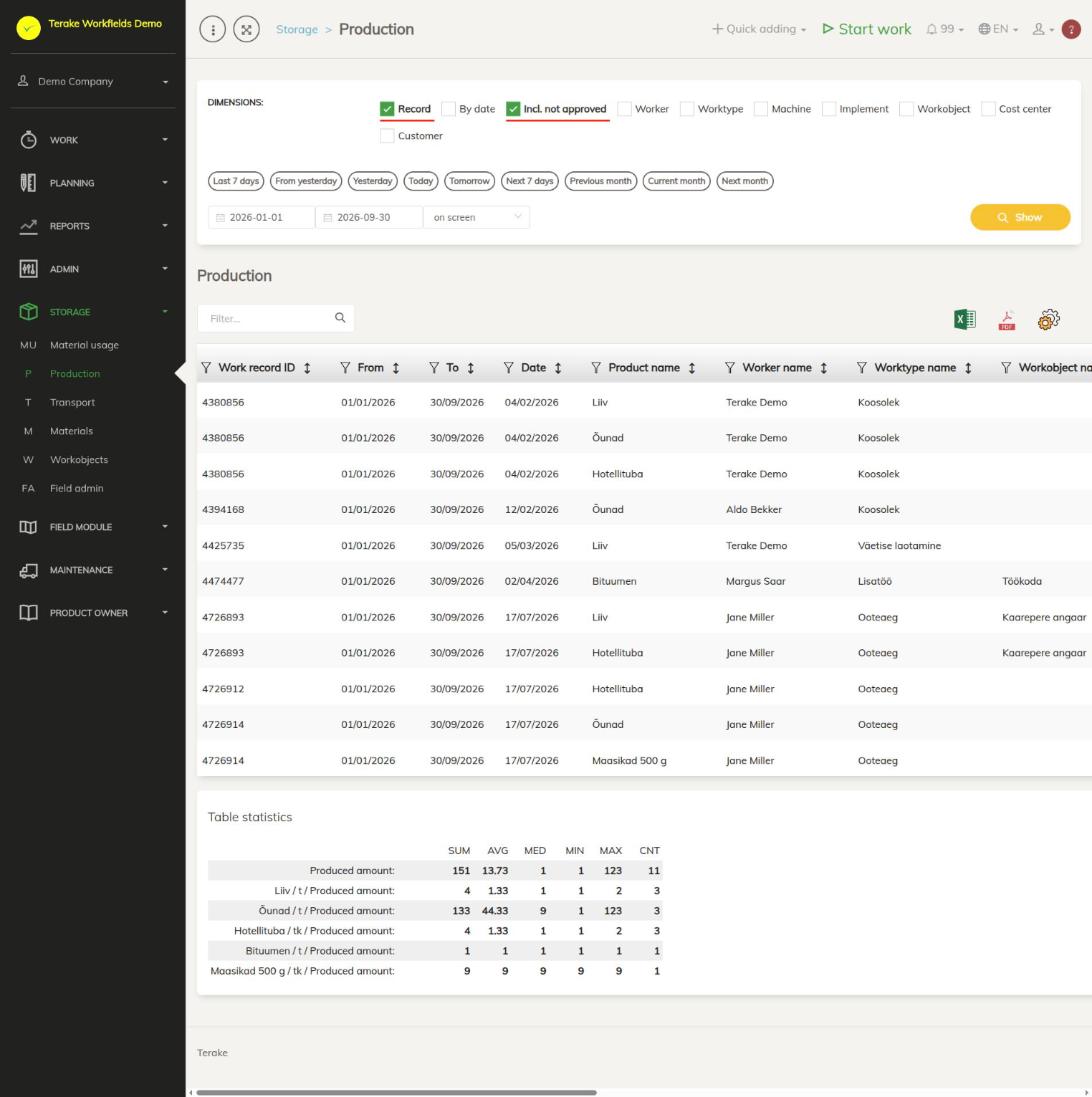
Page layout
- “Dimensions”: “Record” gives a separate row for each product of each work. When “Record” is not selected, amounts are added up by the selected dimensions: “By date”, “Worker”, “Worktype”, “Machine”, “Implement”, “Workobject”, “Cost center” and “Customer”.
- “Incl. not approved”: without this choice only approved work is counted.
- Period: quick choices (“Last 7 days”, “Yesterday”, “Today”, “Previous month”, “Current month” and others) or a start and end date, up to 366 days.
- Output: “on screen” or “MS Excel file”. The report is built with the “Show” button.
- Table: columns such as “Work record ID”, “Date”, “Product name”, “Produced amount”, “Product unit”, “Storage”, “Worker name”, “Worktype” and “Workobject name”. You can hide and order the columns with the “set view” icon.
- Above the table: the search field “Filter…” and the icons “open in Excel” and “open as PDF file”.
- “Table statistics” below the table: the sum, average, median, minimum, maximum and number of rows of the produced amount in total and for each product and unit separately.
How to build the report
- Under “Dimensions”, choose “Record” to see each work separately, or remove it and choose what to sum production by, for example “Worker”, “Workobject” or “Cost center”.
- Tick “Incl. not approved” if you also want to see work that is not approved yet.
- Select the period and “on screen” or “MS Excel file” as the output.
- Press “Show”.
- Narrow down the result with the filter icon in the column header or the search field “Filter…”.
How to view the work behind a row
- Press the row’s list icon in the “Actions” column.
- A list of the work records that make up the row opens. From there you can open a work and change or delete it.
- To see the changes, press “Show” in the report again.
Where the data comes from
Production is recorded in the work on the “Production” tab:
- Open a saved work and select the “Production” tab.
- Select the “Product”. Only materials marked “Product” are offered (see Materials).
- Enter the “Produced amount” and select the “Storage” the production goes to. If you do not select a storage, the production goes to the storage “Undefined”.
- Press the save button.
Production increases the inventory of the selected storage. A work object or field marked “Used as storage” can be selected as the storage.
Who can see it
The storage module is shown to employees who have the role “Stock management”. For other roles the same report is also in the “Reports” menu, see Production.
Tips
- Materials used up are in the report Material usage.
- The current inventory of a product and its movements by storage are on the “Inventory” tab of the material’s window, see Materials.
API calls on this page
For integrations and AI assistants: this page uses the following Terake API calls. The full description is in the API reference.
When the page opens:
GET /api/terakereports/{id}– TerakeReport by IDGET /api/terakereports-data/{report_id}– TerakeReport data
Adding, changing and deleting (from the API description):
DELETE /api/terakereports/{id}– Delete TerakeReport by ID or UUIDPOST /api/terakereports– Creates or modifies a TerakeReportPUT /api/terakereports/{id}– Creates or modifies a TerakeReport
Other calls from this screen’s dialogs and actions (from the web client’s code):
GET /api/materials/{id}– Get MaterialGET /api/materials/{id}/harvest_sources– Harvest Material sourcesGET /api/materials/{id}/material_composition– Harvest Material compositionGET /api/materials/{material_id}/inventory– MaterialInventory of a materialGET /api/terakereports– TerakeReport collectionGET /api/workdones/{id}– Workdone by ID or UUIDPUT /api/workdone/approve/{id}– Approves the Workdone